
Chapter 3 of Terrible Lizards: the flooded electrical rooms, all four fuse circuits, Allosaurus arena hunts and the black biomass, explained.
Terrible Lizards Chapter 3 Walkthrough
Chapter 3 is the point where Dalton's Dinos stops pretending to be a theme park. The route drops into flooded service corridors, the power is out, and the chapter is built around four fuse circuits that have to be restored before the next section opens. The Allosaurus owns the arenas, the black biomass starts coating the walls, and the game stops giving you safe ground to stand on.
This page covers the chapter structure, the fuse logic, the Allosaurus encounters and the slime hazard. It avoids story spoilers beyond what the environment already tells you. If you arrived here straight from the Lake Cave, the Chapter 2 walkthrough is the better place to finish your collectible cleanup first.
Official source: Terrible Lizards on Steam — the store page and developer updates describe the move set and the no-weapons design that defines every encounter in this chapter.
The shape of Chapter 3
The chapter has three repeating beats: a flooded traversal section, a fuse circuit, and an Allosaurus arena. The pattern is not perfectly regular, but it is consistent enough to plan around. Each restored circuit turns on lights or machinery in the next section, which is how the game signposts progress without a map.
The water is the defining hazard. It slows Jordan, hides gaps and makes some surfaces slippery. It does not drown you in the shallow sections, but several rooms flood while you are inside them, which turns a safe route into a timed one. The game rarely gives you more than one clear route out.
The black biomass is the second hazard. It coats floors and walls in the deeper rooms, and touching it is not instantly fatal in every case, but it slows you and marks the areas where the Allosaurus can move without being seen. Treat black-coated surfaces as creature territory rather than as a path.
Chapter 3 introduces more enemies and more clutter, but the damage model has not changed. A single Allosaurus contact kills you. Do not trade a safe route for a faster one just because the room looks open.
Flooded traversal: how to read a water room
Water rooms in Chapter 3 are built around three visual cues. Submerged yellow paint marks the route the developers intend you to take. Bubbling patches mark deep water or a current. Dry ledges above the waterline are almost always the safe line, even when they look like decoration.
The practical rule is to climb first and wade second. If a room has a catwalk, a pipe or a wall-run panel above the water, use it. The water route is usually shorter but exposes you to the Allosaurus and to the flooding timer. The dry route takes longer and keeps your movement speed intact.
Some rooms require you to open a sluice or a pump before the water level drops. These controls are mounted on dry walls, usually near the entrance. If you are stuck in a flooding room, look for a wheel or a lever before you look for an exit; the exit often does not open until the water is moving.
The four fuse circuits
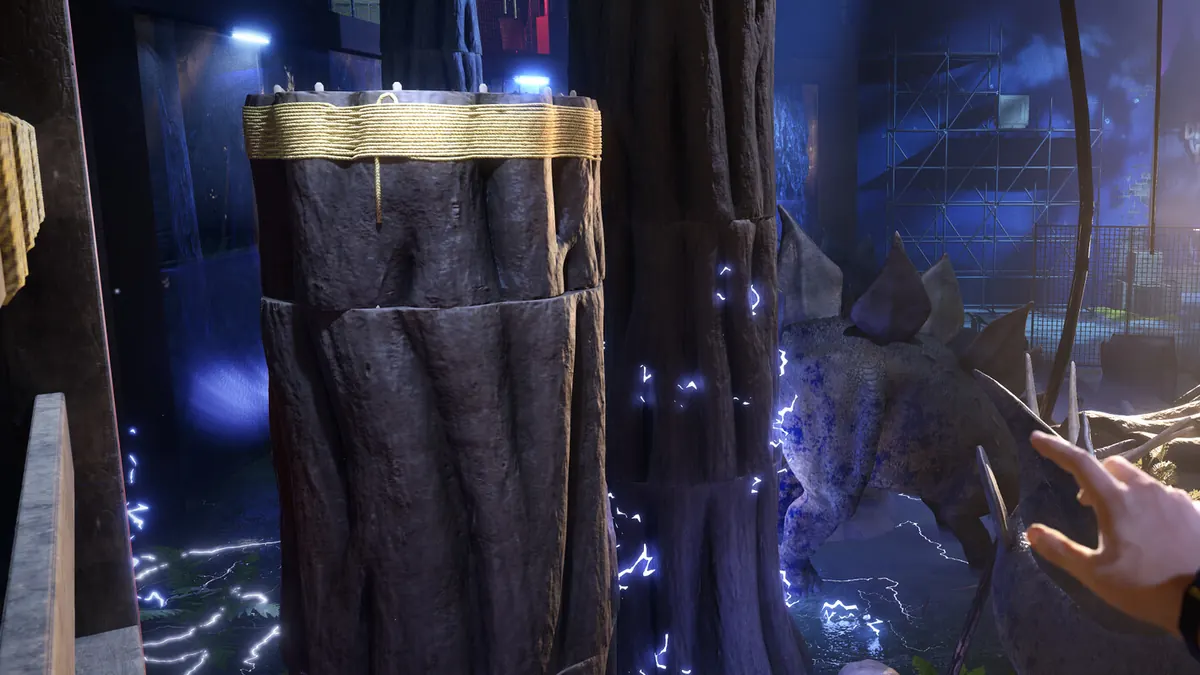
The chapter's main objective is restoring four fuse circuits. Each circuit sits in a flooded electrical room and each one powers the next area. The sequence is linear in practice: the game does not let you skip a circuit, and the route to the next one opens only after the previous circuit is live.
Three things make the fuse rooms easier:
- Find the breaker before the fuse. The breaker is usually at the room entrance and kills the live current in the water. Walking into a live fuse room without pulling it is the most common death in the chapter.
- Clear the room before you interact. Interacting with a fuse takes a moment and locks your movement. If an Allosaurus is in the room, it will use that moment.
- Leave by the route you came in. Restoring a fuse often triggers a scripted event, including a flood or a collapse. The entrance is usually the safest exit until the event settles.
The fuse rooms are also where the chapter's notes cluster. Each one has at least one note on a dry ledge, and the electrical rooms are small enough that a quick lap after restoring the fuse is worth the time. The collectibles page explains how the note sets are tracked.
A live circuit hums. A dead circuit is silent. If you cannot tell whether a fuse room is still dangerous, stop at the door and listen before you step into the water.
Allosaurus arenas
The Allosaurus encounters are arena fights without a health bar. The space closes, the creature circles, and the exits are either locked or too slow to reach in a straight line. You cannot kill it, stagger it or scare it off. The only win condition is reaching the next area.
The arenas share a few design rules. There is always a vertical route: a catwalk, a stack of crates, a wall-run panel or a pipe. There is always a loop that lets you break line of sight without cornering yourself. And there is always a moment when the Allosaurus commits to a charge, which is your window to cross the open floor.
The mistake most players make is treating the arena as a race. The Allosaurus is faster than Jordan in a straight line. Treat it as a patrol puzzle: move when it is committed elsewhere, climb when it is between you and the exit, and never cross the middle of the room while it is facing you.
The Allosaurus file covers its behaviour in more detail, including the difference between the arena encounters and its brief roaming appearances. The bosses page explains why the game's encounters are structured this way.
Black biomass and the deeper rooms
The biomass first appears in Chapter 3 and becomes more prominent in Chapter 4. In gameplay terms it is a surface modifier: it slows movement, obscures yellow paint and marks creature territory. In story terms it is the substance the park was built on top of, and the reason the Coolidges kept digging.
Do not try to clean or burn the biomass. The game does not give you a tool for it. If a route is coated, look for a dry line above it or a vent that bypasses the room. The biomass is also a useful warning: if a corridor is covered in it, an Allosaurus is probably nearby.
The deepest rooms in the chapter connect to the Chapter 4 ascent. Before you take the final transition, check your collectible counters. The fuse rooms are small and easy to sweep, and the chapter does not let you backtrack once the ascent begins.
Chapter 3 checklist before the ascent
- Four fuse circuits restored. The chapter will not end until all four are live.
- Notes in the fuse rooms. Sweep each dry ledge before you leave the room.
- Amber. The chapter has enough samples to matter for New Game Plus; every fourth sample unlocks a modifier.
- Allosaurus arenas cleared. You cannot return to them after the ascent starts.
If the Allosaurus is the wall you are stuck on, read the Allosaurus file before you retry. If the water rooms are the problem, the Chapter 4 walkthrough will not help yet; practice the wall-run timing in the dry sections of Chapter 2 first.
Chapter 3 is the game's hardest chapter for most players because it combines the two systems that punish impatience: water and a predator that closes distance quickly. Once the fourth fuse is live, the chapter is effectively over. The final ascent is shorter, more scripted and more generous with checkpoints, even though it looks more dangerous.
FAQ
How many fuses are in Chapter 3? Four. They are spread across the flooded electrical rooms.
How do you survive the Allosaurus arenas? Use the vertical route. The Allo cannot follow you onto catwalks and wall-run panels.
Is Chapter 3 the hardest chapter? It has the most combat encounters, but the final climb in Chapter 4 is more demanding.
Sources
More Terrible Lizards Guides
Terrible Lizards has no health bars. These are the real boss encounters: the Hybrid, Allo, Bronto, Pterry and the final Dennis chase, with survival notes.
The Bronto in Terrible Lizards: how the roaming Brontosaurus works, how to survive both boulder pursuits, and why it was the hardest creature to build.
Every major character in Terrible Lizards: Jordan, Stella, Dalton, Elena, DJ and Dr. Fellows, plus the four Paleo Pals mascots and their species.
Every collectible set in Terrible Lizards: 16 amber samples, audio tapes, notes, stuffed animals and the Chapter 2 note that most players miss.
The Terrible Lizards demo has two parts: a story section and a gameplay section. What it covers, where to get it and what carries over.
Who is Dennis in Terrible Lizards? The mascot suit, the entity under Dalton's Dinos, DJ's imaginary friend and the evidence behind the main theory.
What happens at the end of Terrible Lizards: DJ, Dennis, the Crew Lift, Stella's car and the questions the game leaves open. Full spoilers.
How long Terrible Lizards takes: 6 to 10 hours for the story, 10 to 12 for completion, chapter-by-chapter estimates and what makes runs longer.